
You have probably read the statistic a dozen times: increasing retention by 5% can boost profits by 25–95%. Maybe you cited it in a deck or used it to justify a loyalty program budget. Perhaps you saw it repeated in three different marketing blogs in a single week. And then you launched the program, watched the numbers for six months, and wondered why your results looked nothing like what the research implied. That isn't a failure of execution. That is a failure of the loyalty program statistics themselves, or more precisely, a failure in how those statistics get passed around.
Most of the loyalty data circulating through ecommerce marketing content traces back to enterprise research conducted on large consumer businesses. These studies weren't looking at independent Shopify stores doing $500K a year. The Bain and Harvard research behind that 25–95% profit figure wasn't studying DTC brands with 3,000 customers and one marketing generalist. Reading those statistics without understanding their origin leads to misaligned expectations. That tends to produce programs that feel like they failed when they were never set up against a realistic benchmark to begin with.
The most-cited loyalty program statistics and where they actually come from
Every few months, someone publishes a loyalty marketing roundup, and the same five statistics appear in it. The 5% retention increase driving 25–95% profit growth. The claim that acquiring a new customer costs 5–7 times more than retaining one. The assertion that loyal customers spend more and refer more. These claims aren't wrong, exactly, but they are stripped of the context that makes them meaningful.
 Many widely repeated loyalty statistics trace back to decades-old enterprise research, not modern ecommerce data.
The 25–95% profit figure traces back to Bain and Company research from the early 1990s, later popularized through a Harvard Business Review article. The study examined large companies in industries like credit cards, insurance, and automobile service. In those sectors, customer switching costs are high and the economics of retention are dramatically different from a customer deciding whether to reorder supplements or skincare from your store. The same is true of the "5 to 7 times more expensive" acquisition cost claim. Kangaroo Rewards cites this figure on its ROI calculator page without a direct link to primary research, attributing it broadly to large consumer business data rather than anything DTC-specific.
What makes this worse is the laundering effect. A statistic from a 1990s Bain study gets cited in a 2016 blog post. That post gets cited in a 2022 roundup, which gets cited again in 2025 content as if it were recently verified. By the time a merchant reads it, the figure has traveled through so many layers of secondary citation that the original methodology is invisible. Novus Loyalty's 2026 CRM analysis, for example, repeats the 5% retention and 25–95% profit claim without adding new primary data. The same is true of most content you will find on loyalty marketing sites.
Antavo's 2026 Global Customer Loyalty Report is a different kind of source and deserves separate treatment. The methodology is real and substantial: 3,000 survey respondents including CMOs, marketing experts, and loyalty professionals; 10,000 loyalty program members globally; and 500 million member actions tracked through Antavo's platform, up from 230 million the prior year. It covers 19 industry sectors and 17 countries. But the sample is concentrated in companies already operating formal, mature loyalty programs. That matters enormously for how you interpret the reported outcomes, and we will come back to that.
The point isn't that these statistics are fabricated. The point is that they describe a population of businesses, programs, and market conditions that may have very little overlap with your store. Before you use any loyalty program statistic to set expectations, the first question is always: who was actually studied here, and are they anything like me?
The enterprise skew problem in ecommerce loyalty data
Most merchants launching a loyalty program for the first time are operating a Shopify store with a customer list under 10,000 names, one person handling all marketing tasks, and no dedicated loyalty budget line separate from general marketing spend. Antavo's report found that among existing program owners, 51.5% of their marketing budgets go to CRM and loyalty. For a bootstrapped brand running lean, that figure is not just aspirational; it is operationally impossible.
 Enterprise loyalty benchmarks rarely reflect the reality of independent merchants running lean operations.
This is what enterprise skew looks like in practice. When the survey sample is dominated by companies running mature, multi-channel programs with dedicated loyalty teams, the reported outcomes reflect infrastructure and investment levels that simply don't exist at independent ecommerce scale. Antavo notes that existing program owners allocate 21.2% more budget than companies that are planning to launch. That gap introduces survivorship bias into the reported satisfaction figures. The operators who stayed in the sample long enough to report results are the ones who already had the resources to build real programs. The merchants who launched thin programs, saw weak results, and quietly shut them down aren't in that data.
The reported 5.3X average ROI and 83% satisfaction rate among program owners are real numbers from real respondents. But they are more likely describing companies with a loyalty manager, a CRM integration, and years of behavioral data than they are describing a small DTC brand in its first year with a program. Antavo doesn't segment ROI outcomes by company size or program maturity in a way that lets a merchant with 2,000 loyalty members place themselves in the distribution. That means the headline numbers are not as useful as they appear.
Independent merchants also tend to have less historical behavioral data to work with, limited integration infrastructure, and no clean separation between their loyalty program's contribution and their other retention marketing activity. What happens when a customer hits month 6 with no reason to stay, and you have no behavioral data to personalize their experience? That is where the gap between enterprise benchmarks and real-world outcomes starts to show up in your revenue. Understanding why retention fails at this stage has less to do with your program design and more to do with the underlying economics of your store.
Loyalty program statistics that are genuinely useful for ecommerce merchants
Not all of the available loyalty data is contaminated by enterprise skew. Some statistics describe consumer behavior and expectation rather than operator outcomes. Those tend to transfer much better across program sizes.
The personalization expectation gap from Novus Loyalty's 2026 CRM analysis is a useful example: 73% of customers expect personalization from brands, but only 33% feel they actually receive it. This describes how customers think and what they want, not what a large program operator achieved with a dedicated team. That means it is more relevant to a smaller store that can close this gap without enterprise infrastructure. A Shopify merchant who sends a relevant reward email at the right moment, based on purchase history, is delivering exactly what that 40-point expectation gap says customers want. You don't need a loyalty team of five to do that. Personalizing touchpoints like birthday campaigns or reminder emails can move the needle without complexity.
The way to stress-test any statistic before you use it is to ask four questions: who was surveyed, what size of program did they operate, how was the key metric defined and measured, and is the figure a median or a mean? A small number of very large programs can pull reported averages well above what a typical merchant would experience. If a statistic can't survive those four questions, it is probably decorative rather than diagnostic.
Benchmarks worth tracking inside your own loyalty program
120 customers per month leaving a store that never built a reason for them to return is a retention problem. Most merchants only notice it when acquisition costs start rising to compensate for the gap. The most reliable benchmarks for an independent merchant are internal, not external. Stores that build measurement discipline around their own data usually outperform stores that borrow external numbers as their targets.
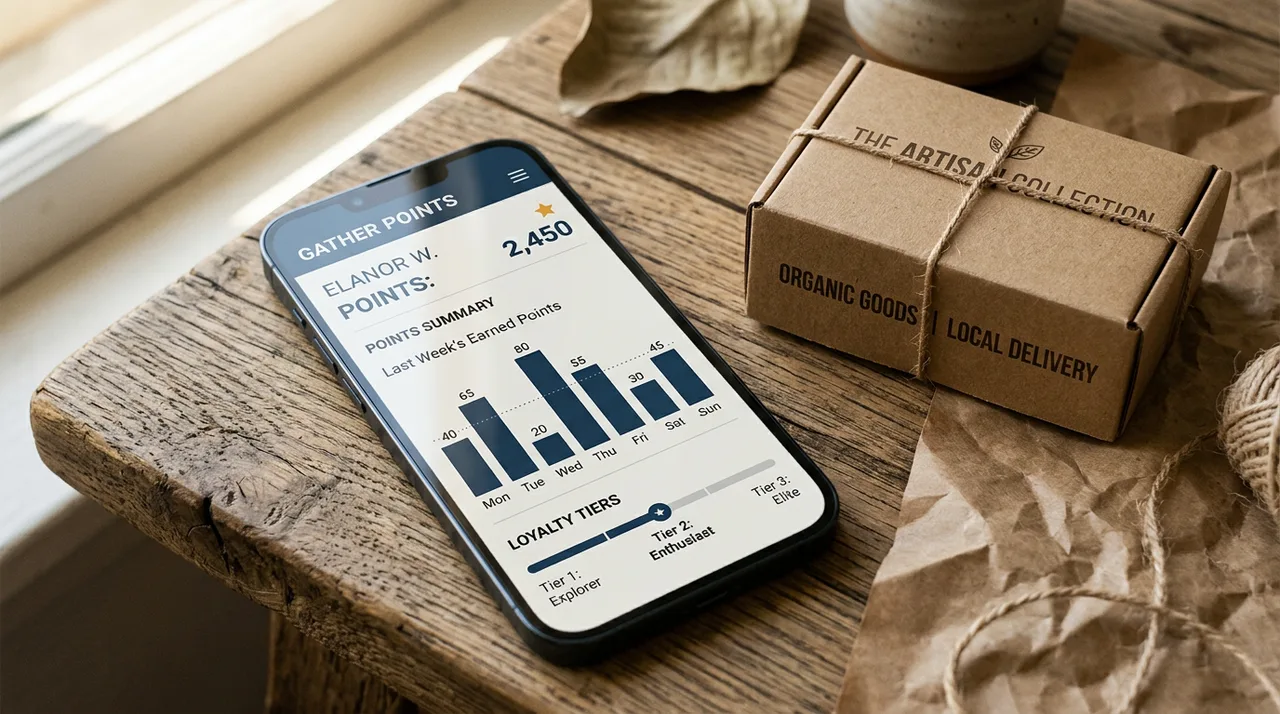 The most actionable benchmarks come from your own program data, not industry averages.
Kangaroo Rewards identifies six metrics as the actual drivers of loyalty program profitability: customer retention rate, repeat purchase frequency, average order value, customer churn rate, referral potential, and reward redemption rates. These six are worth establishing as a pre-program baseline before you launch anything. A baseline gives you something real to compare against six months later. If your repeat purchase rate is 18% before launch and climbs to 24% six months in, that delta tells you more than any industry report can. It reflects your actual customers responding to your actual program design.
Antavo's report found that only 9% of program owners face no data analysis challenges. 36.3% cite data quality and fragmentation issues, and 34.5% report limited integration barriers. That means even large operators struggle with measurement. Internal discipline becomes a genuine competitive advantage rather than just a best practice. If you know your average order value among loyalty members versus non-members and track that gap monthly, you have a more honest picture of your program's contribution than most companies in Antavo's survey do. The customer lifetime value calculation sits underneath all of this and should be the metric your program is ultimately trying to move.
What Antavo's 2026 report actually says for merchants at your scale
9 out of 10 program owners measuring performance reported positive ROI. 89.4% believe loyalty drives unique value not achievable through other channels. Those are encouraging numbers, but they are also self-reported by the people who have invested the most in loyalty programs. That is worth keeping in mind before you treat them as a neutral probability estimate for your own launch.
Self-reported satisfaction data carries a well-documented bias toward positive outcomes, particularly when the respondents are professionals who have staked budget and credibility on the programs they are reporting on. This doesn't mean the numbers are false, but it does mean they should be treated as directional rather than predictive. The figure that 83% of program owners report satisfaction, up from 69.2% the prior year, is more useful as a signal that loyalty programs broadly generate perceived value than as a forecast of what your own program will deliver.
Some of the less-cited findings in Antavo's report are actually more useful for smaller operators. The AI readiness gap is one of them: program owners average 6.3 on Antavo's AI readiness scale, while companies that haven't yet adopted a program average 4.9. The interpretation that matters here isn't about AI specifically. It is that even basic loyalty infrastructure tends to create compounding operational advantages over time, including better data, better segmentation, and better ability to act on customer behavior. That benefit is available at independent merchant scale.
51.4% of marketers now use AI in loyalty management, up from 37.1% the prior year. But that figure describes companies already running formal programs rather than the broader merchant population that has yet to launch one.
What Antavo's report does not say is equally important to note. It doesn't segment ROI or satisfaction data by company size or program maturity in a way that allows a merchant with 2,000 loyalty members to locate themselves within the average. That omission isn't a flaw in the report, which is designed for enterprise loyalty professionals. It does mean the headline figures describe a population that skews toward larger, more mature programs in ways the report doesn't fully quantify.
How to set realistic expectations before you launch a loyalty program
The goal of reading loyalty program statistics shouldn't be to validate the decision to launch. That decision is usually already made, or it is a business question rather than a research question. The goal is to define what success looks like in terms you can actually measure with your own data. Identify early which metrics will tell you whether the program is working before six months have passed and you have spent real budget.
A practical starting point is to define what a successful first six months looks like in three numbers: enrollment rate (what percentage of buyers join the program), redemption rate (what percentage of members actually use their points or rewards), and repeat purchase lift (how your repeat purchase rate changes versus your pre-program baseline). Antavo's finding that 83% of program owners report satisfaction is an encouraging directional signal. But a merchant launching their first program should define satisfaction on their own terms. Perhaps a 10% improvement in repeat purchase rate within the first two quarters is the right target, rather than borrowing a benchmark from operators running programs at a completely different scale. Programs that get used more frequently tend to generate better outcomes than programs that look sophisticated on paper but see low member engagement in practice.
The loyalty program statistics that matter most to your store are the ones you generate yourself, starting from the baseline you establish before launch. Read the industry reports critically, borrow the consumer behavior insights that survive scrutiny, and build your own benchmarks from there.