
Most ecommerce merchants can tell you their ROAS, their CAC, and their conversion rate down to two decimal places. Ask them what ecommerce customer churn is costing them annually, and you will get silence. The revenue leaking out the back door rarely shows up in the dashboards people actually check. Average ecommerce retention rates sit around 25-30%, which means most stores lose 70-75% of their customers every year. That number probably sounds familiar, and what most merchants have never done is multiply it out into actual dollars.
The instinct when churn becomes visible is to reach for discounts. A win-back coupon, a "we miss you" campaign, a 20% off code blasted to lapsed segments. It feels like action and produces a visible revenue bump, but it is nearly always making the underlying problem worse. This article walks through the real cost of churn, the behavioral timeline behind it, why the discount reflex backfires, and what a retention system that does not erode your margins actually looks like.
How to put a real dollar figure on your ecommerce customer churn rate
The calculation most merchants skip is straightforward. Take your monthly churned customers, multiply by your average order value, then multiply again by how many times a retained customer would have purchased in a year. That gives you annualized lost revenue from churn alone.
 Putting a real dollar figure on churn changes retention priorities immediately.
Here is what that looks like in practice. A Shopify store with 2,000 monthly active customers, a 6% monthly churn rate, a $65 AOV, and 3 annual purchases per customer is losing roughly $280,000 in annualized revenue. Before spending a single dollar on replacement acquisition. And that is where the multiplier gets painful: acquiring a new customer costs 5 to 7 times more than retaining an existing one, so the true cost of that churn is not $280,000. It is multiples of that figure once you account for the paid traffic, the ad creative, the email sequences, and the conversion friction required to replace every customer you lost.
Most merchants have never put this number on a spreadsheet. Do it once, and the priority of retention changes immediately.
Why ecommerce customer churn spikes at months 2, 6, and 12
Churn is not random; if you pull cohort data from almost any ecommerce store, the same three windows appear consistently, and each one has a distinct cause.
Month 2 is the easiest to understand and the easiest to prevent. Post-purchase excitement fades fast, and once the product arrived and the customer used it once or twice, daily inbox noise took over. If your store sent an order confirmation and a shipping update and nothing else, the customer has no particular reason to remember you exist. They did not leave angry; they just forgot, because the brand never gave them a reason to come back before a competitor's ad showed up in their feed.
By month 6, the dynamic has shifted. The customer has actively compared alternatives, seen a competitor promotion, or experienced some friction that was never resolved. A slow return, a support ticket that took three days, a product that did not quite match the description. These small failures accumulate quietly, and the customer does not churn with drama. They just redirect their next purchase somewhere else, and you never know why.
Month 12 is the most consequential window, because it is the most intentional. A seasonal repurchase cycle arrives, or a subscription renews, and the customer makes a conscious decision for the first time. Without a concrete reason to stay, points, status, a relationship with the brand, they weigh the options fresh. And with the global ecommerce market projected to reach $6.8 trillion by 2026 and over 2.7 billion people shopping online, your customer has thousands of credible alternatives available in the time it takes to open a new tab.
Understanding these windows matters because it turns churn from an abstract rate into a predictable pattern: month 2, month 6, month 12. If you know when the decision point arrives, you can intervene before it closes. That is a very different posture than sending a win-back campaign after the customer has already left.
The discount trap: why win-back campaigns make churn worse
Here is the problem with the 20% off win-back email: it works, but only short term. A percentage of lapsed customers reactivate, revenue shows up in the attribution report, and the campaign gets labeled a success. What the report does not show is what you just taught those customers.
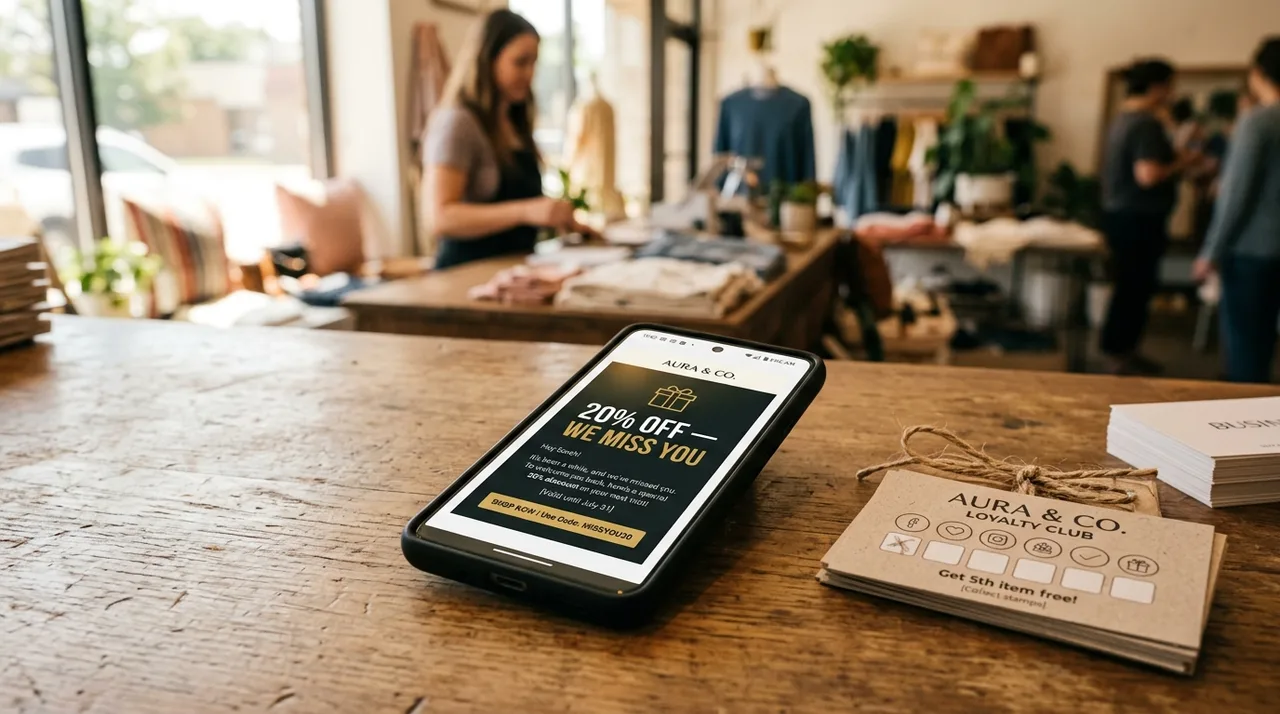 Win-back coupons feel like action but often train customers to wait for discounts.
Price anchoring is the mechanism that makes repeated discounting so damaging. When a customer receives a discount offer every time they go quiet, they learn to wait. The next time they consider a purchase from your store, they delay, knowing the coupon is coming. Their reference price for your product has permanently dropped, and future full-price purchases feel like overpaying. You did not win them back; you trained them to be cheaper customers.
The margin math makes this worse than it sounds, given that ecommerce gross margins typically run 30-50%. A 20% win-back discount on a $65 order does not just reduce profit; on a low-margin product it can erase the entire profit on that order. You paid to acquire the customer originally, you paid again to reactivate them, and you broke even at best on the recovered transaction. The LTV math on a discount-conditioned customer is grim.
There is also a brand perception cost that is harder to quantify but very real. Discounting signals that your normal price is inflated. It positions your brand as a deal destination rather than a value destination. Customers who first engaged with you through a discount, or who have been repeatedly retargeted with coupons, find it psychologically harder to justify paying full price. Over time, you accumulate a customer base that only activates on promotion, which is not a retention strategy but a slow margin erosion.
Merchants keep doing it because the alternative is less visible. A win-back campaign produces an attributable revenue line in a dashboard. The downstream damage, lower LTV per customer, a growing proportion of discount-conditioned buyers, the gradual softening of your brand's price position, compounds silently across quarters. The campaign looks like a win, but the business gets weaker.
Research shows 73% of customers expect personalization from brands, but only 33% feel brands actually deliver it, and most win-back campaigns fail on both dimensions simultaneously. Most win-back campaigns are generic coupon blasts sent to anyone who has not purchased in 90 days: they offer a discount the customer was not asking for, phrased in a way that makes clear you do not actually know them. The customer who left because of a support issue does not need 20% off. They need to know the issue was heard.
What behavioral research says actually reduces churn
The logic of structural retention is different from the logic of win-back campaigns. Instead of reacting to a customer after they have gone quiet, you build conditions that make leaving less attractive before the churn window opens.
Loyalty points, status tiers, and earned rewards create positive switching costs. A customer with 800 points and Silver status at your store is not just a transactional buyer anymore. They have an asset sitting in your ecosystem, and leaving means forfeiting something real. That psychological anchor has nothing to do with discounting, and it does not cost you margin on every reactivation. Done well, it compounds: each purchase deepens the relationship rather than resetting it.
Timing and relevance matter more than offer size. Reaching a customer at the month-2 window with a behavior-triggered message, "here is what you can do with your first loyalty points," lands completely differently than a generic coupon three months after they have already churned. The customer is still warm and the decision is still open, so an intelligent, automated communication at that moment outperforms a large discount sent too late, because it arrives when the customer is still considering rather than after they have already moved on.
Community and identity attachment suppress churn in a way that economics alone cannot. Customers who have referred a friend, left a review, or engaged with a brand's values are harder to dislodge with a competitor's promotion. They have a relationship with the brand, not just a transaction history. Referral mechanics and review incentives are not just acquisition tools. They are retention tools, because the act of advocacy deepens the customer's own commitment to the brand.
Research consistently shows that increasing repeat customers by just 5% can boost profits by 25-95%. That range is wide because it reflects how differently businesses are structured, but the direction is unambiguous. Compounding customer lifetime value through retention outperforms single-transaction revenue recovery by a margin that makes almost every acquisition investment look expensive in comparison. And well-designed loyalty programs can generate up to 5x return on investment precisely because they shift the customer's relationship with the brand from transactional to relational, making each purchase feel like progress toward something rather than a one-off decision.
Building a retention system that does not depend on margin erosion
A retention system has three operational components, and it is worth being precise about what each one does.
 A structured retention system keeps customers engaged without sacrificing margin.
First, a loyalty program that rewards behavior beyond the purchase. Points for referrals, reviews, and social engagement deepen identity attachment before the next churn window arrives. By the time month 6 comes around, a customer who has referred a friend and earned a status tier is not making a neutral comparison between your store and a competitor. They have a position to protect, and this is structurally different from a discount: you are not cutting margin, you are building an asset in the customer's mind. The types of loyalty programs that do this well extend engagement across the full customer lifecycle, not just the point of transaction.
Second, automated lifecycle triggers tied to the known risk windows. Month-2, month-6, and month-12 communications should not require a marketing manager to manually pull a segment and launch a campaign. They should be infrastructure, running continuously, catching every customer at the right moment without active oversight. This is the difference between a tactic and a system: one-off campaigns are tactics, and a system compounds.
Third, a single customer view that connects purchase history, reward status, and engagement signals. When a customer receives a message that references their actual behavior, their points balance, and their specific history with your store, it lands differently than a batch email. The gap between personalization expectations and delivery is where most churn happens. Closing that gap does not require expensive custom development. Platforms like Beans integrate directly with Shopify to automate loyalty and referral mechanics, connect with Klaviyo and Mailchimp for lifecycle communication, and surface the customer data needed to make messages feel relevant rather than generic, without requiring a developer or a separate CRM.
The distinction between tactics and systems is the one worth holding onto. A win-back campaign is a tactic: it requires a decision, a budget, a launch, and it produces a one-time result. A retention system runs whether or not anyone is actively managing it, and its output compounds as the customer base grows.
The math that makes retention your highest-ROI investment
To bring the numbers back together: acquiring a replacement customer costs 5 to 7 times more than keeping an existing one. A 5% improvement in retention can lift profits by 25-95%. Even a modest loyalty program infrastructure investment pays back faster than almost any acquisition channel when you account for the full cost of churn: lost revenue, replacement acquisition spend, and the margin erosion from discount-based win-back attempts.
The reframe worth making is this: ecommerce customer churn is not a marketing problem you patch with a promotion. It is a systems problem that compounds quietly until the acquisition budget can no longer cover the losses. At that point, the business is in genuine trouble, and no win-back coupon fixes a structural deficit. With CAC rising industry-wide and thousands of new stores launching every year, the stores that win are the ones that built retention as infrastructure before they needed it. Not the ones that ran the best coupon the month before it became urgent.